Home / A Conversation with Joshua Serafin and Arka Kinari, participating artists/artist collectives of ‘Wan Hai Hotel: Singapore Strait’
Share this article:
A few years ago, curator X Zhu-Nowell visited Georgetown, Penang, at the invitation of collectors Leong Kwong Yee and Alfred Cheong, whom they had gotten to know after repeated encounters on the art circuit in Singapore and Hong Kong. While exploring the streets of Penang’s Chinatown, Zhu-Nowell chanced upon the Wan Hai Hotel, an atmospheric heritage property on the corner of Love Lane. Wan Hai, translated from Mandarin, approximates ‘circumnavigating the sea’. Zhu-Nowell, who had recently joined the Rockbund Art Museum as its Artistic Director after a lauded stint at the Guggenheim Museum, had been contemplating what it meant to programme for a contemporary art institution situated in Shanghai — a city whose name literally means ‘upon the sea’ — and how to connect Shanghai with the rest of the world. This chance encounter coalesced ideas about the expansive reaches of the ocean, hospitality, and the informal networks that criss-cross the globe, unfettered by borders. In November 2024, Wan Hai Hotel opened at the Rockbund Art Museum, Shanghai; Zhu-Nowell’s curatorial precis describes the project as “a speculative hotel dedicated to the epistemology of seascapes, a space for unmooring…(that) reactivates the connective tissue of a global Chinatown network, a loose constellation unconfined by national boundaries”. At the heart of this creative endeavor are “shared histories and flowing networks rather than isolated territories”: the sea as connector rather than severance.
In January 2026, as part of ART SG’s programming, the international iteration of Wan Hai Hotel will debut in Singapore. Titled Wan Hai Hotel: Singapore Strait, this edition will take place at The Warehouse Hotel, another restored heritage property-turned hotel. Formerly a ‘godown’ or warehouse, constructed in the 1890s during a time of flourishing maritime trade, the Warehouse Hotel sits on the banks of Robertson Quay, in a storied neighborhood that was previously known as a secret society enclave and red light district. This edition will be regionally rooted, and draws upon Singapore’s history as a trading hub as well as its resonance as a site for exchange. Over 11 days the spaces of the Warehouse Hotel will be transformed into sites of encounter, with the exhibition unfolding through site-responsive artistic interventions, installations, film and video, performances and gatherings.
Joshua Serafin
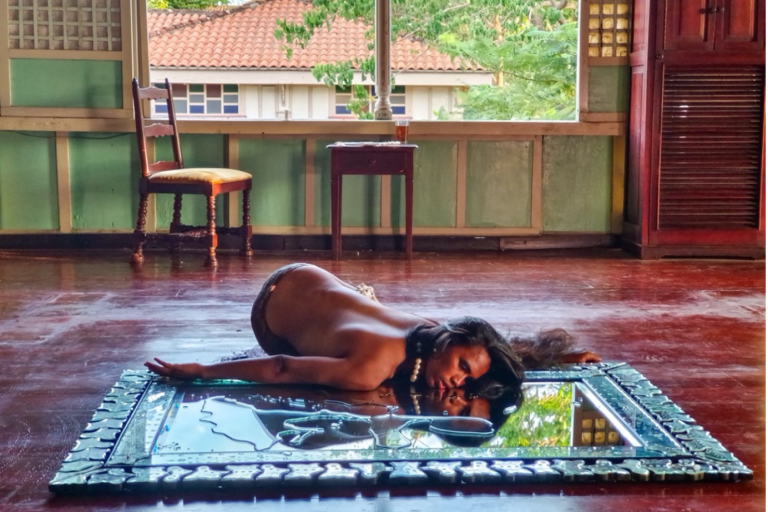
Joshua Serafin (b. 1995, Philippines / Belgium) is an internationally-acclaimed multi-disciplinary artist who combines movement and visual art in works that draw on new forms of ritual and embodiment to address questions about identity, transmigration, states of being and ways of inhabiting the body. Serafin’s work has toured across Europe and East Asia, including a recent presentation at the 60th Venice Biennale curated by Adriano Pedrosa. In Singapore, Serafin will perform Relics: An Eye Once Blind, commissioned by the Rockbund Art Museum for Wan Hai Hotel. Rooted in the artist’s transoceanic family history – beginning with their great-great-grandfather Sentaro Esaki, a first-generation Japanese migrant worker who moved to the Philippines in 1909 – Serafin’s work delves into forgotten narratives, and navigates the disappearance of an identity once tied to a warrior lineage.
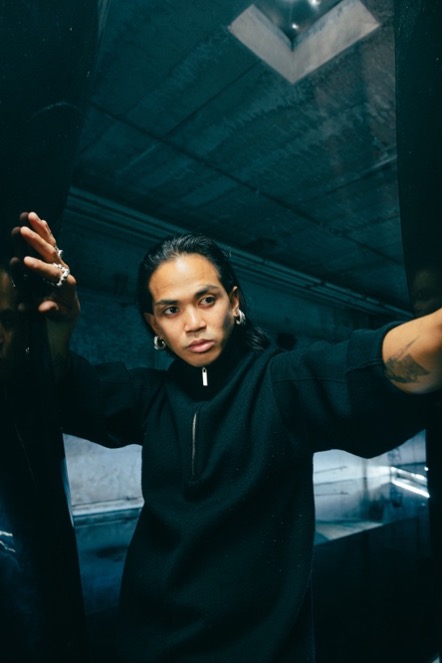
Hello Joshua. You work between the realms of visual art and performance. Could you share a little more about how you got your start in these worlds? Was there a pivotal moment for you when you decided performance was how you wanted to embody your ideas and express yourself?
Joshua Serafin (JS): Hello, I have always been working with my body as a tool, having trained in theatre in Philippine High School for the Arts, while combining Ballet training. I then shifted to contemporary dance in HKAPA (Hong Kong Academy for Performing Arts) and later on finished my Bachelors in Dance in PARTS (Performing Arts Research and Training Studios) in Brussels. I later on took a Bachelors and Masters in Fine Arts in Visual Arts in KASK. I combine all these elements of my background in my work, which is still highly focused on performance and choreography. I have always treated the body as a vessel and these ideas as embodied states, that later on become a choreographic and visual tool in my creations.
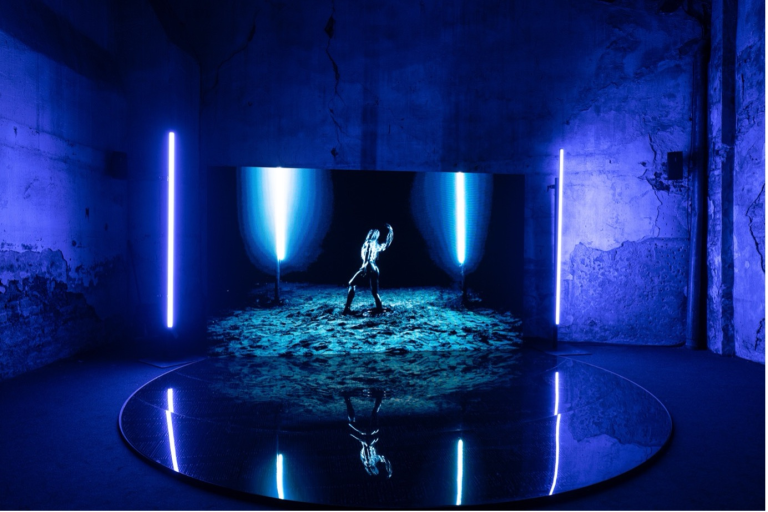
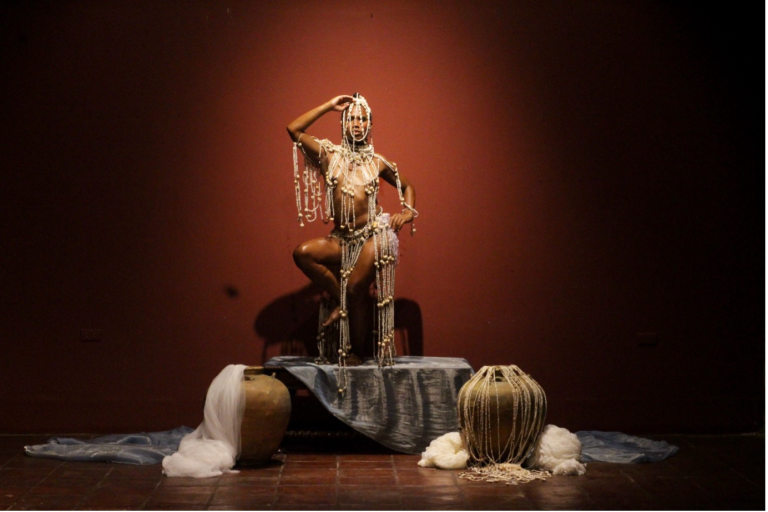
Mythology and cosmological narratives thread through much of your work. What do these other worlds afford you, as an artist and a performer?
JS: World building allows me to propose a different universe, and different possibilities for the kind of society I hope we can live and lead into. These proposals are for me a way to manifest what an ideal world could look like. And in this “world making”, marginalised bodies, and thematics revolving around queerness, spirituality, indigenous technologies, and ecology thrive. This knowledge is the premise of these worlds I’m making. It is not leaning away from the current capitalist world we’re living in, but a critique and commentary — my form of activism in questioning our current realities.
For Singapore Art Week, you will present Relics: An Eye Once Blind. Could you share more about the genus of this work?
JS: Relics is a work-in-progress performance that I am currently developing in the next two years which hopes to find its premiere in April 2027. This is part of a new cosmology and series of work called “Lost Ancestors” The entry point of this research is my great-great-grandfather Sentaro Esaki’s history. He was a Japanese carpenter from Yame city in Fukuoka Japan who moved to the Philippines in 1909, a pre-war migration. It was a time where Japan was sending its people to work abroad, an influx of Japanese migration that led them to Sao Paulo, Argentina, Philippines, Hawaii and many more places in the early 20th century. I did some research in Japan this September in hopes of finding answers about his origins and to answer questions about why he left and moved. I was lucky enough to be able to find our long-lost Japanese family, and I was able to visit the shrine where all my ancestors have been buried. I felt I became a vessel for Sentaro’s earthly desire to bring him back home to his family. He was never able to come back to Japan. He had a family overseas, and war in the region broke out. This work hopes to bring the narratives of the dead alive, as well as fulfilling their desires even in the afterlife. This also navigates the realities and injustice in the amount of killing our world is currently experiencing, and asks – how do we give voice to those who can no longer speak.

Your works are always beautifully staged. Could you talk us through the costumes and objects that are activated during the performance of Relics: An Eye Once Blind?
JS: We are developing new sculptures that are based on Philippine pre-colonial weapon and artifacts. I have designed this new work that reimagines what we think of weaponry. A weapon that is meant to heal, and offer growth and rejuvenation – the opposite of destruction. I am also collaborating with Inneraum and Kuboraum to create a beauty costume for the Singapore show.
Wan Hai Hotel is a poetic exploration of the ocean and its reaches, as a space as well as vessel for identity, memory, community, and all its entanglements. It is also a wonderful metaphor for liminality. Your personal journey and work have brought you across oceans, and I imagine this will continue to be the case following the enthusiastic reception of your work at its Venice Biennale presentation. Within this flux and itinerancy, is there a centre you hold on to? And at this moment in time, could you share with us – where is it you want to be?
JS: Beautiful question. Indeed I have been in motion and movement these past years and it will continue. I have learned, that the center I hold onto right now is the grounding work I do wherever I go, as well as the principles and ideologies I believe in, that I am further honing and defining. More and more my corporeality is just yearning for more spaces of silence, nature, ocean, and surfing, while balancing it with periods of being in intense spaces of visibility and performing, as well as being close to my friends and family and people I love, with whom I am creating a beautiful community together.
ARKA KINARI
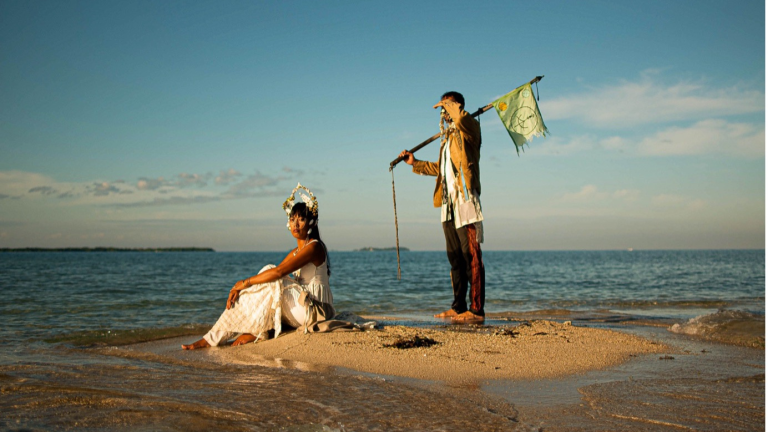
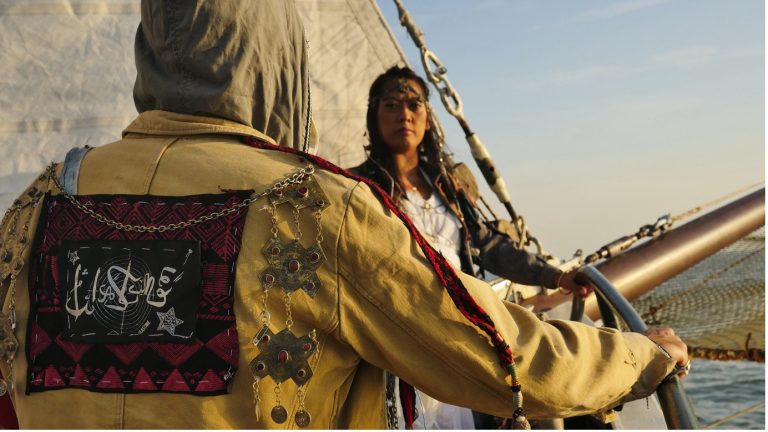
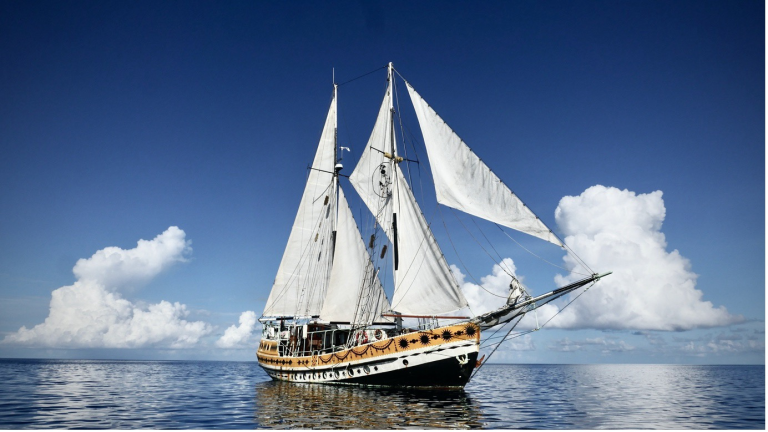
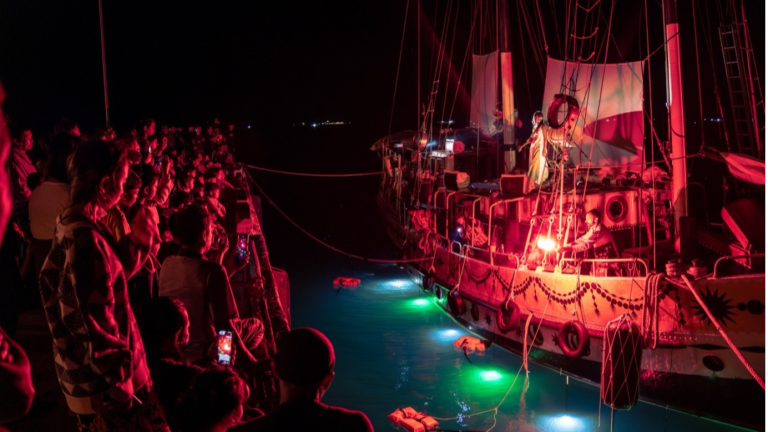
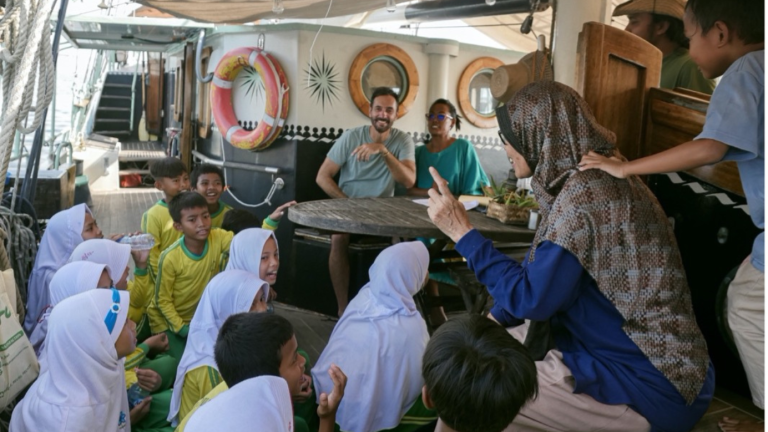
Arka Kinari is a floating cultural platform initiated by artists Grey Filastine and Ruth Nova. Combining the Latin word for ship with the name of a Hindu-Buddhist mythological creature closely associated with music and the arts, Arka Kinari is a seventy-tonne sailing ship on a voyage to promote resilience in the face of climate change, and re-engagement with the last great commons – the sea. By day, Arka Kinari hosts workshops on environmental sustainability and in conversation with local communities; at night, the ship transforms into a stage for performances by Filastine & Nova, using music and cinematic visuals to imagine other ways of inhabiting the world beyond fossil-capitalism. A touring production powered by the wind, moved by the sun, and shared freely on public waterfronts, Arka Kinari is both message as well as method. Wan Hai Hotel: Singapore Strait will present Laut Loud by Arka Kinari, an archive of coastal music cultures.
Hello Filastine & Nova. Can you tell us about how Arka Kinari started?
Filastine & Nova (F&N): Our work, as Filastine & Nova, always focused on frictions between humans and the rest of nature, but as we toured by conventional means, flying from festival to festival, we were complicit in the very system we were trying to fight. Also, these tours necessarily brought us only to places that had money: Europe, the States, Japan, Australia, and rarely within Nova’s home of Indonesia. It took ten years of research to figure out how to adapt our touring method to a sailing ship, where we could tour according to our principles, and reach peoples and places still outside of the frames of the globalised world. Once we had the ship, the other tools and techniques, beyond the title performance, developed naturally.
How did the Laut Loud project come about?
F&N: Laut Loud was initially an adaptation to the pandemic — as we couldn’t throw events with large audiences, we pivoted to hosting artists without an audience, with an attention to filming and recording their unique adaptations to the ship and the water. After the initial sessions we quickly realised that Laut Loud should be a permanent effort, because there are so many unusual musical micro-scenes across the archipelago. We believe that the more time that passes the more valuable Laut Loud’s cultural snapshots will become. As the internet flattens the world and spreads a digital sameness, these musics will mutate or might even mutate.
What is the most important thing that being out at sea has taught you?
F&N: Patience. Infinite patience. Because our pace is so slow, because we are subject to the whims of nature — the seasonal winds, currents, storms, and because our survival is also dependent on the cooperation of a team working together in the limited space of the ship.
What wisdoms can we learn from being at sea, that are particularly urgent or pertinent for these times?
F&N: Someone once called Arka Kinari an anti-fragility project, and I think that might be the accidental lesson learned. The constant challenges of the sea build callouses without reducing care, and this resilience could be applied to the challenges of land and its human civilisations. The polycrisis of ecological, social and political degradation can be weathered in a similar way, letting it wash over us without complaint, while we survive and build our own worlds.
ABOUT THE AUTHOR: TAN SIULI
Tan Siuli is an independent curator with over a decade of experience encompassing the research, presentation and commissioning of contemporary art from Southeast Asia. Major exhibition projects include two editions of the Singapore Biennale (2013 and 2016), inter-institutional traveling exhibitions, as well as mentoring and commissioning platforms such as the President’s Young Talents exhibition series. She has also lectured on Museum-based learning and Southeast Asian art history at institutes of higher learning in Singapore. Her recent speaking engagements include presentations on Southeast Asian contemporary art at Frieze Academy London and Bloomberg’s Brilliant Ideas series.

Share this article: