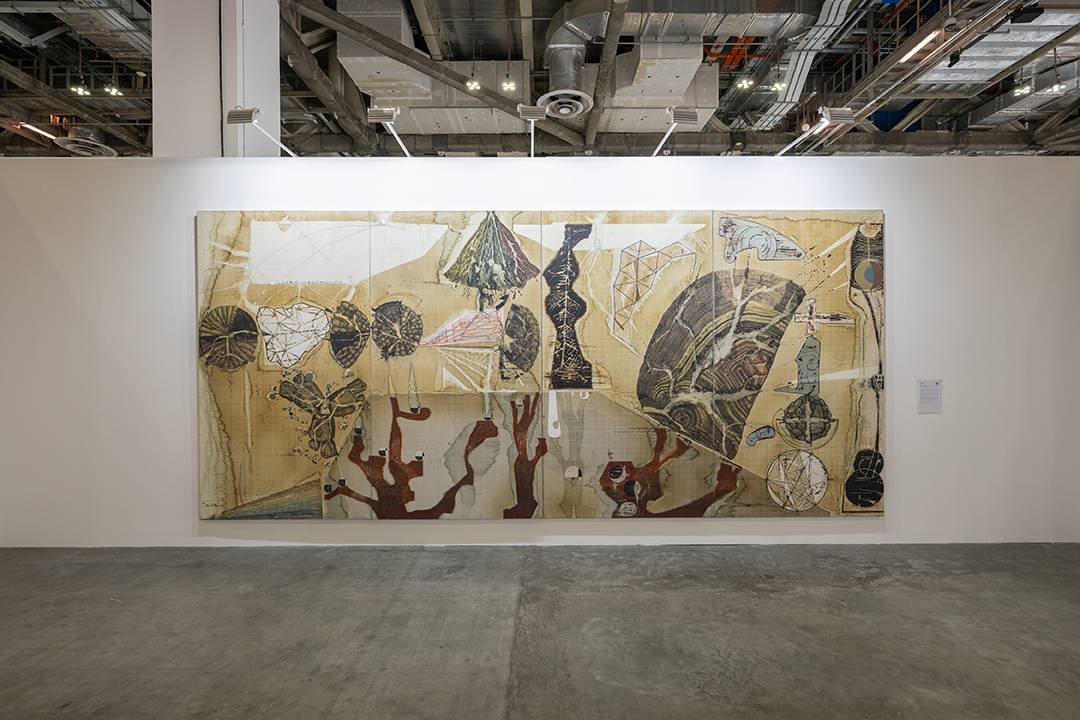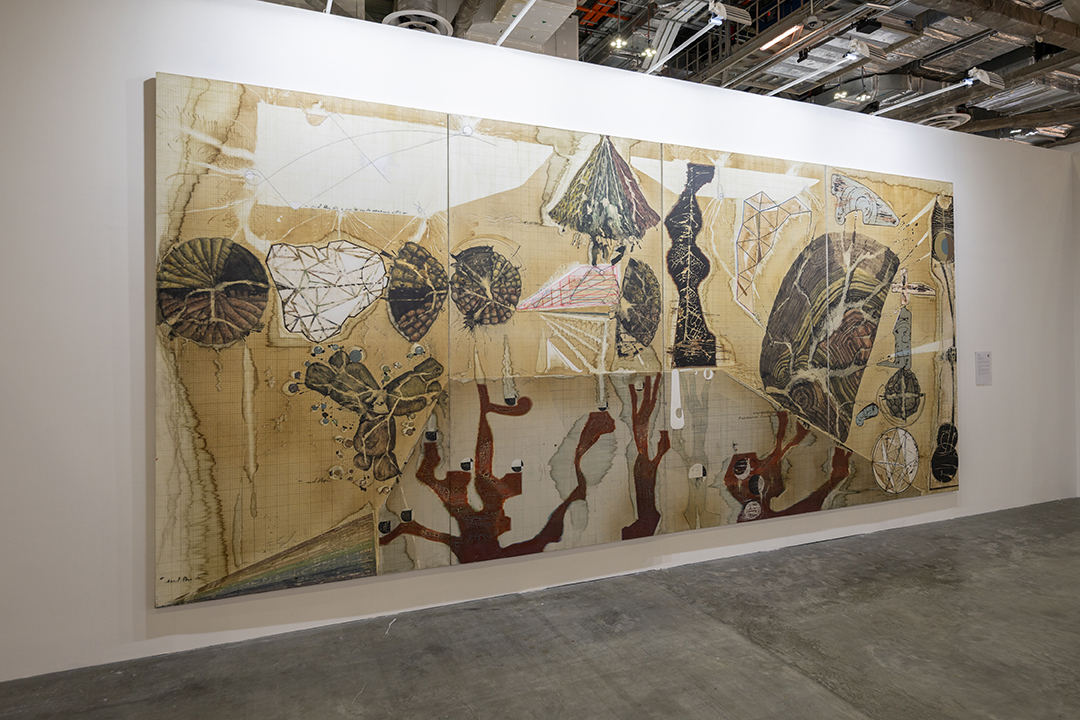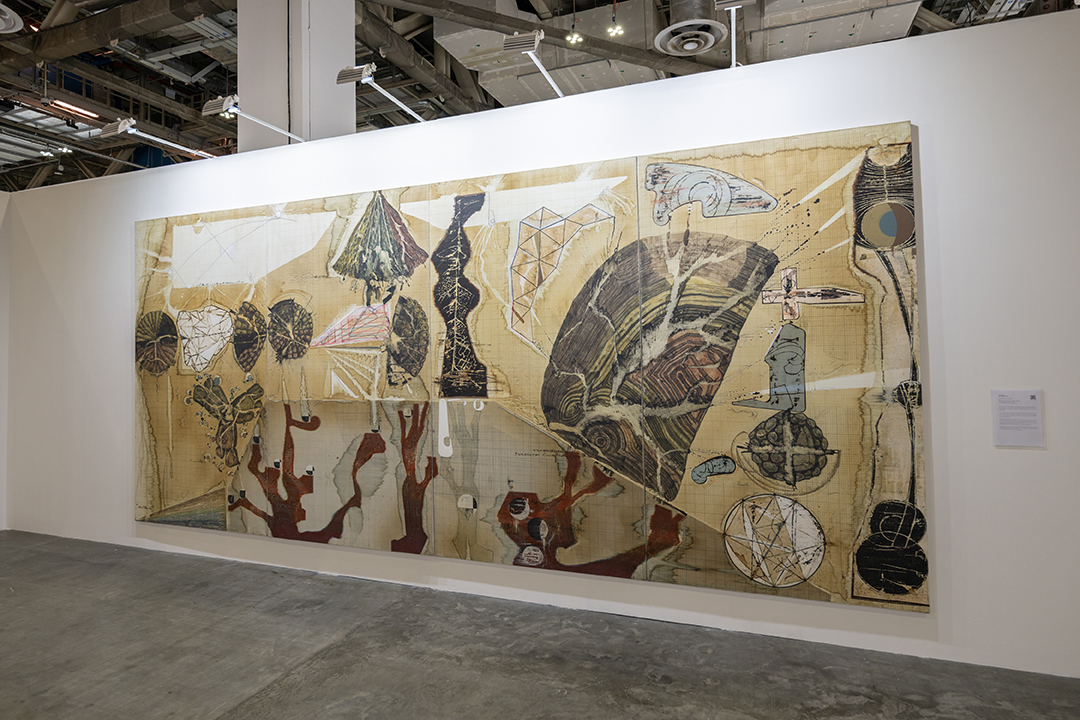
Palindrome Anagram Painting unfolds as an archipelago of forms. It is a speculative abstraction that brings together the terrestrial and the celestial, the geological and the geometric, the oceanic and the botanical. The composition evokes an otherworldly map, yet resists a singular orientation or fixed reading.
The title signals two structuring logics. Like a palindrome, the work mirrors itself across imagined axes, where beginnings and endings fold into one another in a cycle of emergence and dissolution. Like an anagram, elements are rearranged to generate new meanings, allowing latent possibilities to surface from existing forms.
Kallat’s practice consistently involves shifting focal lengths—across space and time—to reframe and explore both the immediate and the imminent. Air and water act as shaping forces, staining, eroding, and slowly transforming the surface. The resulting palette of warm, time-weathered hues recalls aged manuscripts and geological strata. Kallat has likened this chromatic register to “cosmic latte,” the average colour of light emitted by galaxies, as identified by astronomers.
Balancing intention with contingency, Palindrome Anagram Painting occupies what Kallat describes as a “fundamentally unstable” state. This instability is not a lack of order but a condition of continual flux, where beginnings and endings fold into one another.